

Construction tasks nowadays are becoming more complicated, fast-paced, and price-sensitive than ever before. Every choice taken at the starting stage immediately impacts the very last final results of a venture. Among those decisions, one of the most critical is how estimating paintings is dealt with within an agency.
Some firms decide to construct internal teams, whilst others rely upon outside experts for assistance. Both procedures include blessings, obstacles, and long-term implications. Understanding these differences enables contractors, builders, and builders to make smarter economic and operational choices.
In this article, we can explore how in-residence and outsourced estimating models work, what makes them different, and which alternative may suit your commercial enterprise better.
The Foundation of Project Cost Planning
Every successful production project starts with clear information of fee shape and fabric requirements. Without correct making plans, even well-designed projects can face financial strain and delays.
Many contractors rely on established workflows supported by a Construction Estimating Service to ensure accuracy in budgeting and bid coaching. These services help translate drawings and specifications into real global value expectancies that manual choice-making.
A robust estimation basis also improves communication among stakeholders and decreases economic uncertainty.
- Helps define realistic undertaking budgets early
- Improves bid competitiveness within the market
- Reduces the hazard of unexpected fee overruns
Internal Teams and Workflow Control
In-house estimating groups are frequently desired by corporations that want full control over their assignment statistics and internal communication. These teams work closely with venture managers, making sure estimates align with agency requirements and expectations.
A CAD Drafter plays a vital role in this setup by changing architectural ideas into unique technical drawings that estimators can use for accurate calculations. This collaboration helps lessen misunderstandings between design and costing levels.
However, preserving an inner crew requires ongoing investment in salaries, gear, and schooling, which could increase operational costs over time.
- Provides full control over the estimating manner
- Ensures direct conversation among departments
- Requires better long-term economic investment
Technology Integration and Design Accuracy
Modern creation estimation is based closely on virtual equipment, automation, and integrated design structures. Companies that undertake generation-driven workflows frequently experience advanced speed and accuracy in assignment calculations.
In many cases, the Construction Estimating Services company gives access to advanced software programs and up-to-date value databases that assist in improving estimation precision without requiring heavy internal infrastructure.

This technique allows agencies to scale more quickly while maintaining regular high-quality in price forecasting and assignment making plans.
- Improves accuracy through virtual automation equipment
- Reduces guide calculation errors considerably
- Enhances collaboration between design and estimating groups
Financial Risks and Budget Challenges
One of the most important challenges in creating plans is dealing with financial uncertainty. Unexpected modifications in cloth expenses, labour availability, or task scope can disrupt even the most carefully prepared budgets.
| Work Item | Quantity | Unit Cost | Total Cost | Budget Share (%) |
| Masonry Work | $5,000\ sq\ ft$ | $\$12.00$ | $\$60,000$ | $56.3\%$ |
| Flooring | $3,000\ sq\ ft$ | $\$6.00$ | $\$18,000$ | $16.9\%$ |
| Concrete Work | $120\ m^3$ | $\$90.00$ | $\$10,800$ | $10.1\%$ |
| Painting | $3,000\ sq\ ft$ | $\$3.00$ | $\$9,000$ | $8.4\%$ |
| Steel Reinforcement | $8,000\ kg$ | $\$1.10$ | $\$8,800$ | $8.3\%$ |
| Total Estimate | —— | —— | $\$106,600$ | $100.0\%$ |
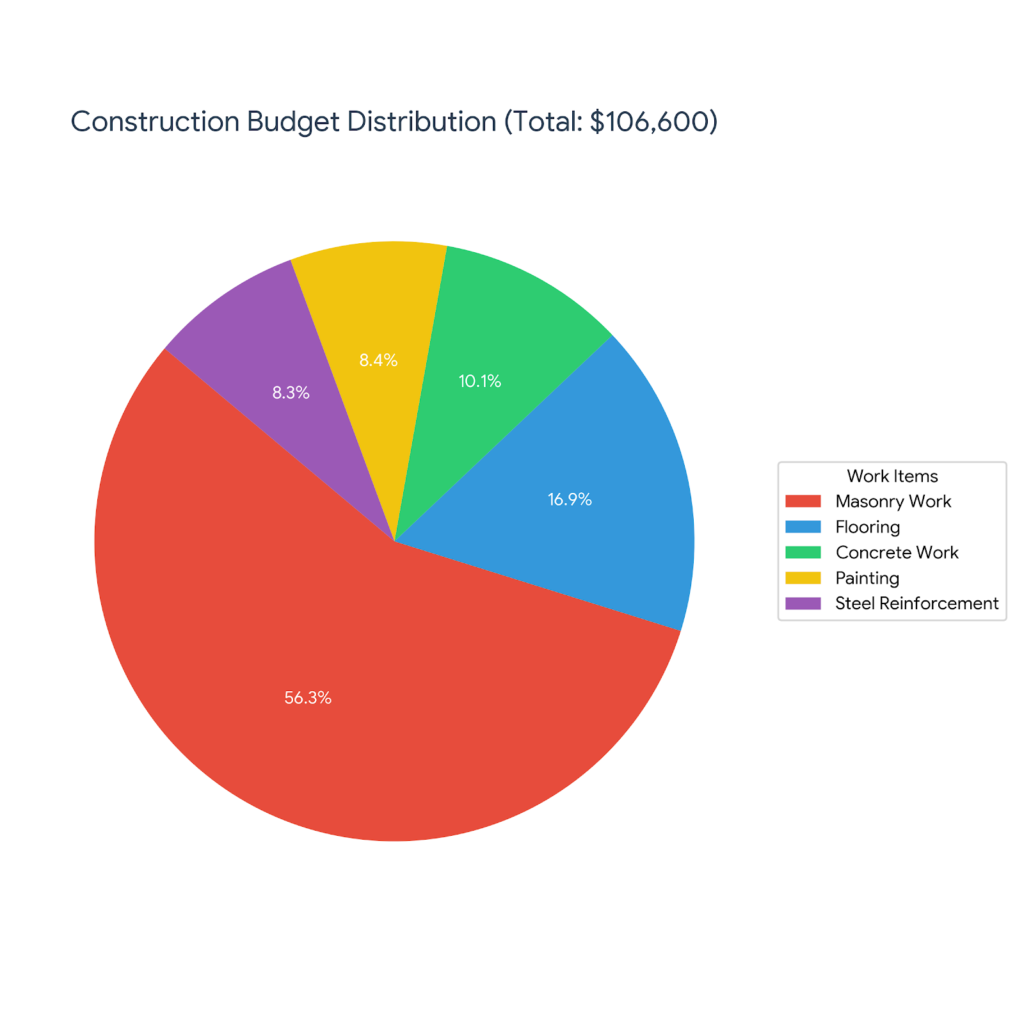
Figure 01: Construction Budget Distribution Breakdown. Visualising the distribution of the total $\$106,600$ project estimate reveals that Masonry Work dominates the financial footprint, commanding a massive $56.3\%$ of the total funding, followed by finishing allocations like flooring ($16.9\%$) and structural foundations ($10.1\%$). Refer to
When handled poorly, estimation errors can cause project delays and reduced income margins. Outsourced or internal estimation fashions ought to both account for market fluctuations and undertaking complexity to remain reliable.
- Strong forecasting systems help corporations stay competitive in bidding and reduce financial exposure in the course of execution.
- Minimises risks associated with budget overruns
- Helps adapt to fluctuating material costs
- Improves decision-making during execution
Choosing the Right Approach for Your Business
Selecting between in-house and outsourced estimating depends in large part on employer size, venture volume, and operational goals. Smaller corporations regularly decide on external assistance because of cost performance, whilst large organisations may also invest in internal groups for better control.
Experience, accuracy, and scalability are key elements when comparing any estimation version. Businesses should additionally recollect turnaround time, knowledge level, and access to trendy equipment before making a final selection.
The proper approach ensures smoother workflows and stronger financial planning throughout all challenge ranges.
- Aligns the estimating technique with business growth dreams
- Balances cost efficiency and operational management
- Improves scalability for the Destiny undertaking expansion
Final Thoughts
The debate between in-residence and outsourced estimating is not about which is higher typical; however, that’s higher acceptable for a selected enterprise version. Both techniques can deliver sturdy effects when implemented successfully.
Companies that prioritise management and long-term consistency may also benefit from internal teams, even as those focused on flexibility and value financial savings might also discover external answers more sensible.
In nowadays’s aggressive production environment, achievement relies upon on choosing a machine that ensures accuracy, performance, and economic clarity.
Both fashions can supply correct project estimates
The decision depends on the company’s length and dreams
Efficiency and accuracy usually need to stay at the pinnacle of precedence
FAQs
1. What is the principal distinction between in-residence and outsourced estimating?
In-house estimating is handled by way of inner workforce, while outsourced estimating is performed by way of outside professionals who focus on price calculations and venture analysis.
2. Which choice is extra value-effective for small creation firms?
Outsourced estimating is normally more cost-effective for smaller corporations as it eliminates the need for full-time salaries, education, and software program funding.
3. Does outsourcing affect the assignment’s first-class or accuracy?
Not always. Many outsourced vendors use superior equipment and skilled experts, who can, without a doubt, improve accuracy if selected wisely.
4. Why do massive companies prefer in-house estimating teams?
Large companies often prefer in-residence teams because they offer better control, faster communication, and alignment with internal venture standards.
5. Can an enterprise use each in-residence and outsourced estimating collectively?
Yes, many corporations use a hybrid method, maintaining core estimating obligations internally even as outsourcing top workloads or specialised tasks.