Solar power is becoming more common in homes today. People want to save money on electricity and use clean energy. But choosing the right solar system part is very important.
One of the biggest choices is the inverter. It helps turn solar energy into usable electricity for your home. Now many people ask one simple question: string inverter vs microinverter which is better for daily use and long-term savings?
In this guide, we will break it down in a very simple way. You will learn how both systems work, what makes them different, and which option fits your home better. If you are confused about string inverter vs microinverter which is better, this article will help you make a clear and smart decision.
String Inverter Vs Microinverter Which Is Better
Let’s understand both systems in a very simple way. This will help you see which one fits your home better.
Basic Meaning Of String Inverter
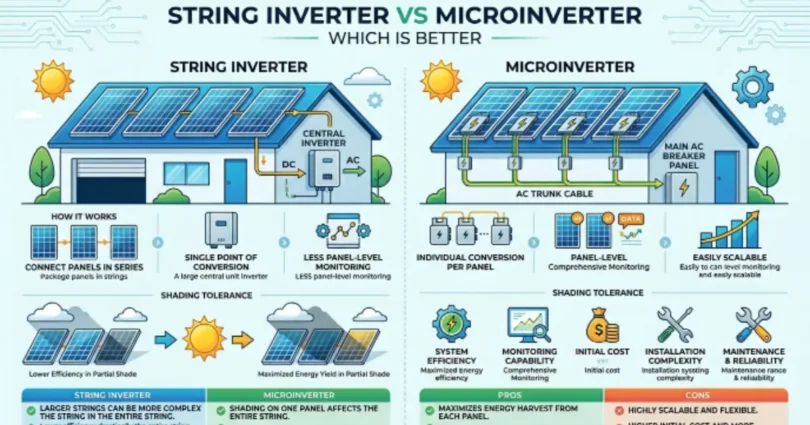
A string inverter is a single device that connects many solar panels together. It changes solar power into usable electricity for your home.
- One inverter handles multiple solar panels
- All panels work as one connected system
- Power flows through a single control unit
- Commonly used in most home solar systems
Simple idea: If one panel has an issue, it can affect the whole system performance.
Basic Meaning Of Microinverter
A microinverter is a small inverter installed on each solar panel. Each panel works on its own.
- One inverter for each solar panel
- Every panel produces power separately
- No full system shutdown if one panel fails
- Works well even in partial shade
Simple idea: Each panel becomes independent, so performance stays more stable.
Simple Comparison Overview
Now let’s compare both systems in an easy way. This helps you understand String Inverter Vs Microinverter Which Is Better for real use.
- Performance: Microinverters handle shade better than string inverters
- Cost: String inverters are cheaper and more budget friendly
- Efficiency: Microinverters give more stable output in different conditions
- Maintenance: String inverters are easier to repair but affect full system if damaged
- Installation: String inverters are simpler for large open roofs
- Flexibility: Microinverters work better for complex roof designs
Quick takeaway:
String inverters are good for simple and low-cost systems. Microinverters are better for high performance and complex roof setups.
How String Inverters Work
A string inverter is a single device that manages power from many solar panels. It is one of the most common systems used in homes.
One Inverter For Many Solar Panels
In this setup, one main inverter controls all connected solar panels.
- A single inverter is installed in the system
- It manages power from multiple panels at once
- It converts DC power into AC power for home use
- It keeps the system simple and low cost
Simple idea: One device does the job for the whole solar system.
Panels Connected In A Chain
All solar panels are linked together in one line, like a chain.
- Panels are connected in series (one after another)
- Power flows through each panel to the inverter
- System performance depends on all panels working together
- If one panel has low output, it can affect the whole chain
Simple idea: All panels work as one team, not individually.
Example: Rooftop Solar System In A Home
Let’s understand it with a real-life example.
- A house installs 10 solar panels on the roof
- All 10 panels connect to one string inverter
- The inverter converts total power into usable electricity
- Home appliances run on this converted solar energy
Simple idea: It is a good choice for simple rooftops with no shading issues.
How Microinverters Work
A microinverter system uses small inverters placed on each solar panel. This helps every panel work separately and gives better control.
One Small Inverter For Each Panel
Each solar panel has its own mini inverter attached.
- Every panel gets its own inverter device
- Power is converted right at the panel level
- No need for one big central inverter
- System becomes more flexible and smart
Simple idea: Each panel has its own small power controller.
Each Panel Works On Its Own
Every panel produces electricity independently.
- One panel does not depend on another
- Performance of one panel does not affect others
- Fault in one panel does not stop the system
- Better energy output in changing conditions
Simple idea: Each panel acts like its own small power system.
Example: Shaded Roof Area Still Produces Power
Let’s understand this with a real home example.
- A house has some panels under tree shade
- Each panel still works at its best level
- Shaded panels do not reduce full system output
- Home still gets steady electricity production
Simple idea: Even if part of the roof is shaded, other panels keep working strongly.
Key Differences Between Both Systems
Let’s compare both systems in a simple and clear way. This will help you understand String Inverter Vs Microinverter Which Is Better in real life use.
Performance In Shade
Shade has a big impact on solar output. Both systems handle it differently.
- String inverter performance drops if one panel is shaded
- All panels in the string can lose efficiency together
- Microinverters handle shade much better
- Each panel keeps working at its own best level
Simple idea: Microinverters perform better in shaded conditions.
Cost Difference
Cost is one of the biggest factors for most users.
- String inverters are cheaper to install
- Microinverters cost more upfront
- String systems are budget friendly for large setups
- Microinverters give long-term value with better output
Simple idea: String inverter saves money at the start, microinverter saves more energy over time.
Maintenance And Repair
Both systems are different when it comes to fixing issues.
- String inverter has one main unit to repair
- If it fails, full system can stop working
- Microinverters are installed on each panel
- Only one panel is affected if a microinverter fails
Simple idea: Microinverters are easier to manage when problems happen.
System Efficiency
Efficiency means how well the system produces power.
- String inverters may reduce output if one panel is weak
- Performance depends on the weakest panel
- Microinverters keep each panel working independently
- This helps improve total system output
Simple idea: Microinverters usually give more stable and balanced efficiency.
String Inverter Vs Microinverter Which Is Better For Homes
Choosing the right system for a home depends on budget, roof shape, and energy needs. Let’s break it down in a simple way.
Best For Small Budget Systems
String inverters are often the first choice for low-cost setups.
- Lower installation cost makes it budget friendly
- Works well for simple rooftop designs
- Good option for large open roofs with no shade
- Easy to install and maintain
Simple idea: If you want to save money at the start, string inverter is a strong option.
Best For Complex Roof Designs
Microinverters work better when the roof is not simple.
- Each panel works independently
- Works well on roofs with shade or different angles
- No power loss from one weak panel
- Better performance in tricky roof layouts
Simple idea: If your roof has shade or different directions, microinverters are better.
Simple Recommendation Based On Usage
Here is an easy way to decide what fits your home.
- Choose string inverter for simple and low-cost systems
- Choose microinverter for high performance and better efficiency
- Think about roof shape before making a choice
- Think about long-term energy output, not just cost
Simple idea: The best choice depends on your roof and your budget, not just the technology.
Pros And Cons Of String Inverters
String inverters are widely used in home solar systems. They are simple and affordable, but they also have some limits.
Low Cost
String inverters are budget friendly for most homeowners.
- Lower upfront price compared to other systems
- Good choice for large solar setups
- Helps reduce total installation cost
- Easy to fit in small budgets
Simple idea: You spend less money at the start.
Easy Installation
These systems are simple to set up.
- One inverter for many panels
- Less wiring complexity
- Faster installation process
- Works well for basic roof layouts
Simple idea: Installation is quick and simple.
Affected By Shading
Shading can reduce overall performance.
- One shaded panel can affect full system output
- Efficiency drops in partial shade areas
- Not ideal for trees or tall buildings nearby
- System depends on all panels working well
Simple idea: Shade can reduce total power generation.
Pros And Cons Of Microinverters
Microinverters offer better performance but come at a higher cost. They are ideal for complex rooftops.
High Performance
Microinverters give strong and stable output.
- Each panel works at its best level
- No system loss from weak panels
- Better energy production overall
- Works well in different weather conditions
Simple idea: You get more stable power output.
Better For Shaded Roofs
These systems handle shade very well.
- Each panel works independently
- Shaded panels do not affect others
- Better output in mixed lighting conditions
- Ideal for roofs with trees or buildings nearby
Simple idea: Shade does not hurt full system performance.
Higher Cost
Microinverters are more expensive.
- Higher installation cost than string inverters
- More equipment needed per panel
- Not ideal for tight budgets
- Long-term savings may balance cost
Simple idea: You pay more at the start for better performance.
Which One Should You Choose
Choosing between string inverter and microinverter is not hard. You just need to look at your budget, roof type, and energy needs.
Simple Decision Guide
Here is a quick way to decide the right option for your home.
- Look at your budget first
- Check your roof shape and shading
- Think about how much electricity you need
- Decide if you want low cost or high performance
Simple idea: Your home situation decides the best system.
Based On Budget
Money plays a big role in this choice.
- Choose string inverter for lower upfront cost
- Good for people who want simple and affordable setup
- Choose microinverter if you can spend more at start
- Better long-term performance may balance the cost
Simple idea: Tight budget fits string inverter better.
Based On Roof Type
Roof design affects system performance a lot.
- Simple and open roof works well with string inverter
- No shade means better performance for string systems
- Complex roofs work better with microinverters
- Shade and different angles favor microinverters
Simple idea: Complex roofs need microinverters for better results.
Based On Energy Needs
Your electricity usage also matters.
- Small homes with low usage can use string inverter
- Good for basic daily power needs
- High usage homes benefit from microinverters
- Better efficiency helps in long-term savings
Simple idea: Higher energy needs match better with microinverters.
Conclusion
Both string inverters and microinverters are good for solar systems. Each one works best in different situations.
String inverters are a smart choice if you want a lower cost setup and have a simple roof. Microinverters are better if your roof has shade or different angles and you want better performance.
There is no one perfect option for everyone. The best choice depends on your budget, roof type, and energy needs. Think about your home carefully before you decide.