Most solar systems lose up to 20% of their energy before it ever reaches your lights. Not because of bad panels. Because of a device most homeowners never think twice about.
Understanding how does a solar inverter work is the single most important thing you can learn about your solar setup. The inverter is the brain of your entire system. Without it, your panels cannot power a single appliance.
Here’s the thing. Most people research solar panels for weeks but spend five minutes on the inverter. That’s completely backwards.
So how does a solar inverter work exactly? It takes raw electricity from your panels and transforms it into power your home can actually use. By the end of this guide, you’ll know exactly how does a solar inverter work, which type fits your home, and what to watch for to protect your investment.
What Exactly Is a Solar Inverter and Why Does Your Solar System Need One?
A solar inverter is the device that converts the raw electricity your panels produce into the type of electricity your home or business actually uses. Without it, your entire solar setup cannot power a single light bulb.
The One Job Every Solar Inverter Has to Do
Let me explain this simply. Your solar panels produce DC power. Direct Current. But every appliance in your home runs on AC power. Alternating Current. Those two types of electricity are not compatible. The inverter’s one job is to bridge that gap.
Here’s the thing. It does this job every second the sun is shining. Quietly, automatically, and continuously. Most homeowners never think about it until something goes wrong.
- It converts DC electricity into usable AC electricity
- Your solar panels generate Direct Current, which flows in one direction only. Your home’s wiring and appliances need Alternating Current, which changes direction rapidly. The inverter makes that conversion happen instantly and continuously, all day long.
- It regulates the voltage coming into your home
- Raw power from solar panels can fluctuate depending on cloud cover, shading, and temperature. The inverter smooths those fluctuations out before the electricity enters your home. You get stable, consistent power delivery instead of unpredictable surges.
- It communicates with the utility grid
- In grid-tied systems, the inverter constantly syncs with your utility grid’s frequency and voltage. If the grid goes down, the inverter shuts off automatically to protect utility workers. This is a required safety feature in every grid-connected solar system in the USA.
- It monitors your system’s performance in real time
- Most modern inverters come with built-in monitoring software. You can check your energy output, spot drops in performance, and catch problems early through a phone app or web dashboard. Think of it as your solar system’s health report, updated live.
What Happens to Your Solar System Without an Inverter
No inverter means no usable power. Full stop. Your panels could be soaking up perfect California sunshine all day and your home would still run entirely on grid electricity.
The truth is, skipping or skimping on the inverter is the most common and costly mistake in solar installations. Here is exactly what breaks down without a proper one.
- Your panels produce power you cannot use
- DC electricity from solar panels cannot run your refrigerator, air conditioner, TV, or any standard appliance. Without an inverter converting it to AC, that power has nowhere useful to go. It is essentially wasted energy sitting at the edge of your system.
- You lose the ability to feed excess energy back to the grid
- Net metering is one of the biggest financial benefits of going solar in the USA. It lets you send unused power back to the grid and earn credits on your bill. Without an inverter syncing your system to the grid, net metering is completely impossible.
- Your battery storage becomes unusable for home power
- Even if you have a battery bank installed, the stored DC energy still needs an inverter to become usable AC power inside your home. Without it, your batteries can store energy but your home cannot access it for everyday use.
- You have no system monitoring or fault detection
- Modern inverters act as the diagnostic center of your solar setup. They flag errors, track daily output, and alert you to panel issues. Without an inverter in place, you are running blind with no way to know if your system is performing or silently failing.
How Does a Solar Inverter Work Step by Step?
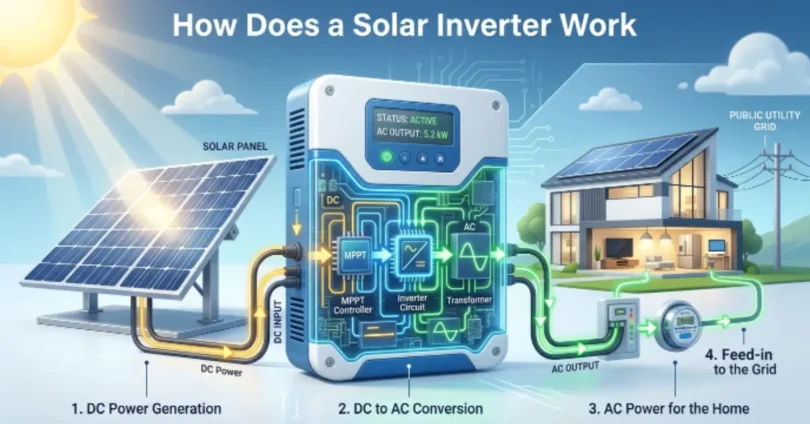
A solar inverter works by taking raw DC electricity from your panels, converting it into AC electricity, and sending it through your home or business in real time. The whole process happens automatically, every single day, from sunrise to sunset.
Step 1: Your Solar Panels Produce DC Power
Here’s the thing. The moment sunlight hits your solar panels, electricity starts flowing. But that electricity is not ready to use yet. Not even close.
Your panels are made of photovoltaic cells. When photons from sunlight strike those cells, they knock electrons loose and create a flow of electricity. That flow moves in one direction only. That is what makes it Direct Current, or DC power.
- Each solar panel produces a fixed DC voltage output
- A standard residential solar panel typically produces between 30 and 40 volts of DC electricity on its own. In a string system, multiple panels are connected in a series, which adds those voltages together. By the time that electricity reaches your inverter, it could be anywhere from 200 to 600 volts DC depending on your system size.
- DC output changes constantly based on sunlight conditions
- Your panels do not produce a steady, fixed amount of power all day. Output rises as the sun gets stronger in the morning, peaks around midday, and drops toward evening. Cloud cover, shading from trees or nearby buildings, and seasonal changes all affect how much DC electricity your panels are sending to the inverter at any given moment.
- Multiple panels feed into the inverter as a combined DC input
- In most home and business solar setups, several panels are wired together before connecting to the inverter. The inverter receives all of that combined DC power as a single input. It then begins the conversion process using that raw, variable DC electricity as its starting point.
- DC power alone cannot run anything in your home
- This is the key point most people miss. All that DC electricity your panels are producing is completely unusable for your appliances, lighting, and devices in its current form. Your home runs on AC power. The inverter is the only thing standing between that raw solar energy and actual, practical electricity you can use.
Step 2: The Inverter Converts DC to AC Power
This is where the real work happens. The inverter takes that raw, variable DC power and transforms it into clean, stable AC electricity that matches your home’s electrical system exactly.
Let me explain how it does that. Inside the inverter, a component called a transistor switches the DC current on and off thousands of times per second. That rapid switching creates a wave pattern. The inverter then shapes that pattern into a smooth sine wave, which is the same wave pattern your utility grid delivers. That is AC power.
- The inverter uses a process called PWM or MPPT to manage input power
- Maximum Power Point Tracking, or MPPT, is the technology most modern inverters use to get the most out of your panels at all times. It constantly adjusts the electrical load on your panels to find the exact point where they produce maximum output. In real terms, MPPT can improve your system’s energy harvest by 20 to 30 percent compared to older inverter technology.
- The inverter shapes DC into a smooth AC sine wave
- Your home’s electrical grid runs on a precise sine wave pattern at 60 Hz in the USA. Your inverter must produce AC electricity that matches that frequency and voltage exactly. If it doesn’t, your appliances won’t run properly and your system won’t sync with the grid. A high-quality inverter produces what engineers call a pure sine wave output, which is clean enough to run even sensitive electronics.
- The inverter regulates voltage to match your home’s electrical standard
- In the USA, standard home voltage is 120V or 240V AC depending on the circuit. The inverter steps up or steps down the converted AC electricity to match those standards precisely. This happens automatically with no input needed from you. Your appliances receive stable, correctly-rated power every time.
- Heat management keeps the conversion process efficient
- Converting large amounts of electricity from DC to AC generates heat inside the inverter. Quality inverters have built-in cooling systems, either passive heat sinks or active cooling fans, to manage that heat. In practice, most residential inverters operate at 95 to 99 percent efficiency, meaning very little energy is lost during the conversion process.
Step 3: AC Power Flows Into Your Home or Business
Once the inverter produces clean AC electricity, it sends that power directly into your electrical panel. From there, it flows to every outlet, light, and appliance in your building just like grid electricity does.
Think about it this way. From your perspective as a homeowner or business owner, solar power feels identical to grid power. You flip a switch and the lights come on. The inverter handles everything in the background.
- AC power enters your main electrical panel first
- The inverter connects directly to your home’s breaker box or main electrical panel. The converted AC electricity flows in and gets distributed across all your circuits instantly. Your home does not know or care whether that electricity came from the sun or the utility grid. It uses whichever source is available without any interruption.
- Solar power is used in your home before grid power is drawn
- Your system is set up to use solar-generated electricity first. The grid only kicks in when your panels are not producing enough to meet your current demand. In practice, on a sunny afternoon your solar system can power your entire home with zero electricity drawn from the utility company.
- For businesses, the inverter can be sized to cover large energy loads
- Commercial solar inverters operate on the same principle but at much higher capacity. A business running heavy equipment, HVAC systems, or lighting across a large facility needs a three-phase inverter system. These systems can handle hundreds of kilowatts of output while maintaining the same conversion process your home system uses on a smaller scale.
- The inverter syncs with your grid connection in real time
- Your inverter constantly monitors the grid’s voltage and frequency. It matches its own AC output to those exact values before allowing electricity to flow. This synchronization happens automatically and ensures your solar power integrates cleanly with your existing electrical system without any manual adjustment on your part.
Step 4: Excess Power Goes to the Grid or Battery
Here is where your solar investment really starts paying off. When your panels produce more electricity than your home or business is using at that moment, the leftover power has to go somewhere. It goes to your battery storage system if you have one, or back to the utility grid.
The truth is, this step is where smart system design makes a huge financial difference. How your inverter handles excess power directly affects your monthly savings and your return on investment.
- Excess power flows to your battery storage system first
- If you have a home battery like a Tesla Powerwall or an Enphase storage system, your inverter sends surplus power there before anything else. That stored energy is available at night, during cloudy days, or during a grid outage. In practice, a well-sized battery and inverter combination can keep your home running through most evening hours on stored solar energy alone.
- Without a battery, excess power feeds back into the utility grid
- When there is no battery storage in your system, the inverter exports unused solar electricity directly to the grid through your utility meter. This is called net metering. Your utility company tracks how much you send back and credits that amount against the electricity you draw from the grid at night or on low-production days.
- Net metering credits can significantly reduce your electricity bill
- In many US states, net metering programs credit you at the full retail rate for every kilowatt-hour you send back to the grid. Some homeowners with well-sized systems and favorable net metering policies bring their monthly electricity bills close to zero. The inverter’s ability to manage this two-way power flow is what makes net metering possible.
- Hybrid inverters manage both battery and grid export simultaneously
- A hybrid inverter is designed to handle battery charging, home power supply, and grid export all at the same time. It decides in real time where power should go based on your current usage, battery charge level, and grid conditions. For homeowners who want maximum energy independence and savings, a hybrid inverter is the most capable and flexible option available.
What Are the Different Types of Solar Inverters and Which One Should You Choose?
There are four main types of solar inverters available for homes and businesses in the USA. Each one works differently, costs differently, and fits a different type of installation. Choosing the wrong type is one of the most expensive mistakes you can make in a solar setup.
String Inverters
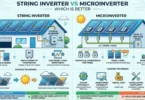
A string inverter is the most common and most affordable inverter type used in residential and commercial solar systems. It connects a series of solar panels, called a string, to one central inverter unit that handles all the conversion work.
Here’s the thing. String inverters have been the industry standard for decades. They are reliable, well-understood, and easy to service. But they come with one significant limitation that you need to know before you buy.
- All your panels feed into one central inverter unit
- In a string inverter setup, your panels are wired together in a series before connecting to a single inverter. That inverter converts all the DC power from the entire string at once. This makes the system simple to install, straightforward to maintain, and less expensive upfront compared to other inverter types.
- One shaded panel can drag down your entire system’s output
- This is the biggest drawback of string inverters. Because all panels in a string are linked together, the weakest panel sets the performance ceiling for the whole group. If one panel is shaded by a tree branch, a chimney, or even bird droppings, your entire string produces at that lower level. In practice, this can cost you a noticeable amount of energy on partially shaded roofs.
- String inverters are the best fit for simple, unshaded rooftops
- If your roof has a clean, south-facing surface with no shading issues and all panels face the same direction, a string inverter is a smart, cost-effective choice. Most straightforward residential installations across the USA use string inverters successfully for 10 to 15 years without major issues.
- Top string inverter brands in the USA include SolarEdge, SMA, and Fronius
- These manufacturers offer reliable string inverters with good warranty coverage, typically 10 to 12 years, and strong monitoring software. SMA and Fronius are especially popular in commercial installations. SolarEdge pairs its string inverters with power optimizers, which solves the shading problem while keeping costs manageable.
Microinverters
A microinverter is a small inverter attached directly to each individual solar panel. Instead of one central unit converting power for the whole system, every panel does its own conversion independently.
Think about it this way. With microinverters, every panel on your roof is its own self-contained power station. What happens to one panel has zero effect on the others. That independence is both their biggest strength and the reason they cost more.
- Each panel operates and converts power completely independently
- Because every panel has its own microinverter, shading, dirt, or a fault on one panel does not affect the rest of your system at all. In a string inverter setup, one bad panel hurts everyone. With microinverters, the other panels keep performing at full capacity regardless. This makes a real, measurable difference on roofs with any shading or multiple orientations.
- Microinverters give you panel-level performance monitoring
- With a microinverter system, you can see exactly how much power each individual panel is producing through an app or web dashboard. If one panel starts underperforming, you know immediately which one it is and where to send a technician. In practice, this level of detail makes diagnosing and fixing problems significantly faster and cheaper.
- They are the best choice for complex rooftops and shaded installations
- If your roof has multiple angles, faces different directions, or has shading from trees, chimneys, or nearby structures, microinverters are worth the extra investment. Enphase Energy is the dominant microinverter brand in the USA and their IQ8 series is widely used in both residential and small commercial installations.
- Microinverters cost more upfront but can deliver better long-term returns
- A microinverter system typically costs 15 to 20 percent more than a comparable string inverter setup. However, on shaded or complex roofs, the additional energy harvest can offset that cost difference within a few years. Microinverters also carry longer warranties, often 25 years, which matches the lifespan of the solar panels themselves.
Power Optimizers with String Inverters
Power optimizers are devices attached to each panel, just like microinverters, but they do not convert DC to AC at the panel. Instead, they condition and optimize the DC power from each panel individually before sending it to a central string inverter for conversion.
Let me explain why this matters. You get the panel-level optimization benefits of microinverters combined with the simplicity and lower cost of a string inverter. It is a middle-ground solution that works very well for a lot of homeowners.
- Each panel gets its own optimizer to maximize individual output
- A power optimizer monitors and adjusts the DC output of each panel independently. It ensures every panel operates at its own maximum power point regardless of what the other panels in the string are doing. This eliminates the weakest-link problem that affects standard string inverter setups and recovers energy that would otherwise be lost to shading or mismatch.
- The optimized DC power still flows to one central string inverter
- Unlike microinverters, power optimizers do not perform the DC to AC conversion themselves. They clean up and stabilize the DC electricity from each panel, then send it to a central inverter for the actual conversion. This keeps the main inverter simple, serviceable, and less expensive to replace if something goes wrong after the warranty period.
- SolarEdge is the most widely used power optimizer system in the USA
- SolarEdge dominates this segment of the market with their HD-Wave inverter and P-series optimizers. Their system comes with built-in panel-level monitoring and a strong 12-year inverter warranty with a 25-year warranty on the optimizers. In practice, SolarEdge systems are one of the most commonly installed combinations by professional solar installers across the country.
- Power optimizers are a smart choice for roofs with partial shading
- If your roof is mostly simple but has some shading on a portion of the panels, power optimizers give you a meaningful performance upgrade over a plain string inverter without the full cost of going all-microinverter. You get better energy harvest, detailed monitoring, and a system that is still straightforward for a technician to service.
Hybrid Inverters
A hybrid inverter combines the functions of a standard solar inverter and a battery inverter into one single unit. It manages your solar panels, your battery storage, your home’s power supply, and your grid connection all at the same time.
The truth is, if you are planning to add battery storage now or even thinking about it in the future, a hybrid inverter is the smartest long-term investment you can make in your solar setup.
- A hybrid inverter manages solar, battery, and grid power simultaneously
- Standard inverters only handle solar-to-grid power flow. A hybrid inverter adds battery management on top of that. It decides in real time whether to use solar power directly, charge your battery, draw from stored battery power, or pull from the grid. This automatic decision-making happens continuously based on your energy usage, battery level, and solar production at any given moment.
- It gives you true energy independence and backup power capability
- With a hybrid inverter and a battery bank, your home can keep running during a grid outage. The inverter detects when the grid goes down and switches to battery power almost instantly, often within milliseconds. For homeowners in areas with frequent outages or unreliable grid supply, this backup capability alone can justify the investment in a hybrid system.
- Popular hybrid inverter options in the USA include SolarEdge, Enphase, and Solax
- The SolarEdge Energy Hub and Enphase IQ8 with IQ Battery are two of the most widely installed hybrid systems in American homes. Solax and Growatt offer more affordable hybrid options that are gaining traction in the market. All of these systems come with smartphone monitoring apps that show your solar production, battery status, and home energy consumption in real time.
- Hybrid inverters cost more upfront but future-proof your entire system
- A hybrid inverter typically costs between 1,000 and 3,000 dollars more than a standard string inverter. But if you plan to add batteries later, retrofitting a non-hybrid system costs significantly more than installing a hybrid inverter from the start. In practice, most solar installers now recommend hybrid inverters as the default choice for new residential installations across the USA.
How Efficient Is a Solar Inverter Really? What the Numbers Mean for You
Most solar inverters operate at 95 to 99 percent efficiency. That sounds impressive. But that small percentage gap between a good inverter and a great one can translate into hundreds of dollars of lost energy every single year.
What Is CEC Efficiency and Why Does It Matter?
CEC efficiency is the real-world efficiency rating that matters most when comparing solar inverters. It stands for California Energy Commission efficiency, and it is the standard used across the entire USA solar industry to measure how well an inverter performs under actual operating conditions.
Here’s the thing. Manufacturers love to advertise peak efficiency numbers. Peak efficiency is what the inverter achieves under perfect, controlled lab conditions. CEC efficiency is what it actually delivers on your roof, in real weather, across a full day of variable sunlight. Those two numbers are not the same.
- CEC efficiency measures real-world performance across multiple power levels
- Unlike peak efficiency, which is recorded at one ideal operating point, CEC efficiency averages the inverter’s performance across six different power levels. This gives you a much more accurate picture of how the inverter will perform throughout a typical day. A day of solar production includes morning warm-up, midday peak output, afternoon decline, and cloud cover interruptions. CEC efficiency accounts for all of that variation in a single number.
- A CEC efficiency rating of 97 percent or higher is what you should look for
- In practice, top-tier inverters from brands like Enphase, SolarEdge, and Fronius consistently achieve CEC efficiency ratings between 97 and 99 percent. A cheaper inverter with a CEC rating of 93 or 94 percent might seem like a small difference on paper. But on a 10 kilowatt system, that 3 to 4 percent gap can cost you 300 to 500 kilowatt-hours of lost energy every year. That is real money left on the table.
- You can verify any inverter’s CEC efficiency rating before you buy
- The California Energy Commission publishes a publicly available list of all certified inverters with their official CEC efficiency ratings. Your solar installer should be able to pull this up for any inverter they recommend. If they cannot tell you the CEC rating of the inverter they are proposing for your system, that is a red flag worth taking seriously.
- Higher efficiency inverters pay for themselves through better energy harvest
- A premium inverter with 98 percent CEC efficiency costs more upfront than a budget option at 94 percent. But over a 10 to 15 year period, the additional energy harvest from the higher-efficiency unit typically recovers that price difference and then some. Think about it this way. You would not put a cheap carburetor in an expensive engine. Your inverter deserves the same logic.
How Shading and Temperature Affect Inverter Output
Shading and heat are the two biggest real-world factors that reduce what your inverter actually delivers. Understanding both of them helps you set realistic expectations and make smarter decisions about your system design.
The truth is, no solar system performs at its rated capacity all day every day. But how much it underperforms depends heavily on how well your inverter handles these two conditions.
- Partial shading can reduce inverter output far more than you expect
- When even a small section of your solar array is shaded, the impact on a string inverter system is disproportionately large. If one panel in a 10-panel string drops to 50 percent output due to shading, the entire string can be pulled down close to that level. In practice, a single tree branch casting a shadow across two panels on a summer afternoon can reduce your system’s output by 30 to 40 percent for those hours. This is exactly why MPPT technology and panel-level optimization exist.
- Solar inverters have an optimal operating temperature range
- Most residential inverters are designed to operate efficiently between 32 and 113 degrees Fahrenheit. Above that range, the inverter’s internal components heat up and efficiency drops. Many inverters have built-in thermal management systems that automatically reduce output to protect the hardware when temperatures climb too high. In hot states like Arizona, Texas, or Florida, this thermal derating can be a real factor in your system’s daily output during summer months.
- Inverter placement directly affects how heat impacts your system
- Where you install your inverter matters more than most homeowners realize. An inverter mounted on a south-facing exterior wall in direct afternoon sun will run hotter than one mounted in a shaded garage or on a north-facing wall. In practice, installers in warm climates recommend shaded, well-ventilated indoor locations wherever possible. Keeping your inverter cooler extends its lifespan and protects its efficiency over the long term.
- MPPT technology is your best defense against shading and output loss
- Modern inverters with advanced MPPT controllers constantly scan your array for the best available power point and adjust in real time. When shading moves across your roof throughout the day, a good MPPT algorithm recovers as much energy as possible from the unaffected panels. Some high-end inverters use dual or triple MPPT inputs, which means they can optimize separate sections of your array independently. For roofs with any shading complexity, this feature alone is worth paying for.
How Do You Know If Your Solar Inverter Is Working Properly?
Your inverter tells you when something is wrong. You just need to know what to look for. Catching a problem early can save you weeks of lost energy production and hundreds of dollars in repair costs.
Warning Signs Your Inverter Has a Problem
Most inverter problems do not happen suddenly. They show up gradually through small, easy-to-miss signals. Here’s the thing. By the time your inverter completely stops working, it has usually been underperforming for days or even weeks.
- Your electricity bill goes up without any change in your usage habits
- This is the most common early warning sign that homeowners notice first. If your solar system was consistently covering a portion of your bill and that coverage suddenly shrinks, your inverter may be converting power inefficiently or dropping output without triggering a visible error. Always compare your monthly bill against the same month last year before assuming it is a rate increase.
- The inverter display shows a fault code or error light
- Most modern inverters have an LED status light or a small display screen that shows error codes when something is wrong. A green light means normal operation. A red or amber light means the inverter has detected a fault and needs attention. Do not ignore these lights. Look up the specific error code in your inverter’s manual or the manufacturer’s app immediately.
- Your monitoring app shows a sudden unexplained drop in daily output
- If your inverter’s monitoring software shows that yesterday’s production was significantly lower than a similar sunny day last week, something changed. It could be shading, a failing panel, or the inverter itself starting to underperform. In practice, a drop of more than 15 to 20 percent on a clear day with no obvious cause is worth investigating right away.
- The inverter makes unusual noises like buzzing, clicking, or humming
- A healthy inverter operates quietly. Some low-level fan noise is normal during peak production hours. But loud buzzing, irregular clicking, or a high-pitched hum that was not there before are signs of internal component stress. These sounds often indicate capacitor wear or cooling fan failure. Left unaddressed, they can lead to a complete inverter shutdown.
How to Read Your Inverter Display or App
Reading your inverter’s display or monitoring app takes less than two minutes once you know what each number means. Most homeowners never look at this data. That is a mistake because it is the fastest way to confirm your system is performing the way it should.
Let me explain the key numbers you will see and what they are actually telling you.
- Daily energy production shows how much power your system generated today
- This number is displayed in kilowatt-hours and resets every morning. On a sunny day, a typical 6 to 8 kilowatt residential system in the USA should produce between 24 and 40 kilowatt-hours. If your daily production is consistently lower than those numbers on clear days, your system is underperforming and the inverter’s data is telling you to investigate.
- Current power output shows how much electricity your system is producing right now
- This is a real-time figure displayed in watts or kilowatts. It rises and falls throughout the day with sunlight intensity. At peak midday sun, a 6 kilowatt system should be producing close to its rated capacity. If current output is significantly below what you expect on a bright afternoon, that is a live signal that something is limiting your system’s performance at that moment.
- Lifetime energy production tracks your system’s total output since installation
- This cumulative number tells you the total kilowatt-hours your system has ever produced. You can use it to calculate whether your system has delivered on the projections your installer promised. Divide your total lifetime production by the number of months since installation and compare it to your installer’s estimated monthly output figure.
- Error logs and fault history show past problems even after they clear themselves
- Most inverter apps store a history of fault codes and error events even after the inverter recovers and resumes normal operation. Checking this log occasionally is good practice. A fault that triggered once and cleared might be minor. The same fault appearing repeatedly is a pattern that signals a developing problem worth reporting to your installer before it becomes a full failure.
How Long Does a Solar Inverter Last and When Should You Replace It?
A solar inverter typically lasts between 10 and 15 years for most types. Your solar panels, on the other hand, are warrantied for 25 years. That gap means most homeowners will need at least one inverter replacement during the life of their solar system.
Average Lifespan by Inverter Type
Not all inverters age at the same rate. The type of inverter you choose at installation directly affects how long you will go before facing a replacement cost. Here is what the real-world numbers look like by inverter type.
- String inverters typically last 10 to 15 years under normal conditions
- String inverters are single centralized units with more components concentrated in one place. They handle the full conversion load of your entire array every day. In practice, most string inverters start showing performance decline or require replacement somewhere between the 10 and 15 year mark. Brands like SMA and Fronius have strong reputations for reaching and exceeding the upper end of that range with proper installation and maintenance.
- Microinverters are designed to last 25 years matching your panel warranty
- Because each microinverter handles only one panel’s worth of power, the stress on each individual unit is much lower than on a string inverter. Enphase, the leading microinverter brand in the USA, warranties their units for 25 years. In practice, the distributed design means a single unit failing does not take down your whole system. You replace only the one affected unit, not the entire inverter system.
- Power optimizers last up to 25 years while the string inverter still needs replacement
- In a SolarEdge setup, the power optimizers themselves carry a 25-year warranty. The central string inverter they connect to still has the typical 10 to 12 year lifespan. This means you will likely replace the central inverter unit once during your system’s life while the optimizers keep working. Budgeting for that inverter replacement in year 10 to 12 is a smart financial planning step for any SolarEdge system owner.
- Hybrid inverters generally last 10 to 15 years depending on battery cycling
- Hybrid inverters manage more electrical tasks than standard inverters, which adds some additional wear over time. How often your battery charges and discharges also affects the inverter’s internal components. Quality hybrid inverters from SolarEdge and Enphase are built to handle this workload, but longevity depends heavily on installation quality, operating temperature, and how hard the system works daily.
Signs It Is Time for a Replacement
Sometimes your inverter does not fail completely. It just quietly starts costing you money. Knowing when to replace it rather than repair it is an important financial decision for any solar system owner.
The truth is, an aging inverter that is producing at 85 percent of its original capacity is still costing you 15 percent of your potential solar savings every single day it stays in the system.
- Your inverter is past its warranty period and showing performance decline
- Once your inverter is beyond its warranty period, repair costs come entirely out of your pocket. If a post-warranty inverter needs a significant repair, the cost of that repair versus the cost of a new, more efficient replacement unit is a calculation worth making carefully. In many cases, a new inverter with better efficiency and a fresh warranty is the smarter financial choice.
- Repair quotes are coming close to the cost of a new unit
- If a technician quotes you a repair cost that is 40 to 50 percent of what a new inverter would cost, replacing it is almost always the better decision. A repaired old inverter still has aging components throughout the rest of the unit. A new inverter gives you full efficiency, a new warranty, and often better monitoring technology than what you had before.
- Your energy production has declined steadily year over year
- Some annual decline in solar output is normal, typically around 0.5 percent per year for panels. But if your system’s output is dropping by 5 to 10 percent year over year, the inverter is likely the cause rather than the panels. A professional performance audit can confirm whether the inverter is responsible and whether replacement is the right next step.
- Better inverter technology now available can meaningfully improve your returns
- Inverter technology has improved significantly over the last decade. If your current inverter is 10 or more years old, a modern replacement unit will almost certainly offer higher CEC efficiency, better MPPT performance, improved monitoring, and smarter grid integration. In practice, upgrading an aging inverter can recover enough additional energy production to partially offset the replacement cost within a few years.
5 Practical Tips to Get the Most Out of Your Solar Inverter
Getting the most from your solar inverter is not complicated. A few smart habits and one or two good decisions at installation can make a measurable difference in your system’s performance and lifespan. Here are five tips that actually matter in practice.
Tip 1: Install Your Inverter in a Cool, Shaded Location
Where your inverter lives matters more than most people realize. Heat is the number one enemy of inverter efficiency and lifespan.
- Avoid direct sunlight and hot exterior walls for inverter placement
- An inverter mounted on a south-facing exterior wall in a state like Texas or Arizona can reach operating temperatures that trigger thermal derating on most summer afternoons. Thermal derating means the inverter automatically reduces its output to protect itself from overheating. In practice, moving the inverter to a shaded garage wall or an indoor utility room can prevent this performance loss entirely and extend the unit’s lifespan by years.
- Make sure there is adequate airflow around the inverter at all times
- Most inverters need at least 12 inches of clear space around them for proper ventilation. Stacking boxes or equipment against your inverter blocks the airflow its cooling system depends on. Check the manufacturer’s installation guidelines for your specific unit and make sure your installer follows those clearance requirements from day one.
Tip 2: Check Your Monitoring App at Least Once a Week
Your inverter’s monitoring app is one of the most valuable tools your solar system gives you. Most homeowners install the app and never open it again. That is leaving a lot of useful information on the table.
- Weekly checks help you catch performance drops before they become costly problems
- Spending two minutes each week looking at your daily and weekly production totals lets you spot trends early. If production starts declining on similar weather days week over week, you will notice it quickly rather than waiting months until it shows up on your electricity bill. Early detection means faster fixes and less lost energy over time.
- Compare your production against the same week last year for accurate context
- Day-to-day weather variation makes it hard to judge performance accurately on any single day. Comparing this week’s production to the same week in the previous year gives you a much more meaningful benchmark. Most monitoring apps, including Enphase Enlighten and SolarEdge mySolarEdge, store years of historical production data that makes this comparison simple.
Tip 3: Keep Your Solar Panels Clean to Protect Inverter Performance
Your inverter can only work with the power your panels send it. Dirty panels mean less DC input, which means less AC output, regardless of how good your inverter is.
- Dust, pollen, and bird droppings reduce panel output and stress your inverter
- In dry climates like California, Nevada, and Arizona, dust accumulation on panels is a real and significant issue. Studies have shown that dirty panels can lose 15 to 25 percent of their output in dry, dusty conditions. That reduced input makes your inverter work harder to track maximum power points and can contribute to unnecessary wear over time.
- Clean your panels two to four times per year depending on your local conditions
- For most homeowners in the USA, cleaning panels two to four times a year is enough to maintain good performance. Use plain water and a soft brush or hire a professional panel cleaning service. Avoid abrasive cleaners or high-pressure washers that can damage the panel surface or protective coating.
Tip 4: Schedule a Professional Inverter Check Every Two to Three Years
Your inverter works silently every day and rarely asks for attention. That silence does not mean everything is fine. A professional check every two to three years catches problems that monitoring apps alone cannot detect.
- A technician can test internal components that are not visible in your monitoring data
- Monitoring apps show you output numbers. They do not show you the condition of internal capacitors, cooling fans, or DC connection points inside the inverter. A qualified solar technician can inspect these components directly, clean internal connections, check for moisture ingress, and identify early signs of wear before they affect performance or cause a failure.
- Professional checks are especially important as your inverter approaches its warranty end
- The last year or two before your inverter’s warranty expires is the most important time to schedule a professional inspection. If a technician identifies a developing fault while the unit is still under warranty, the manufacturer covers the repair or replacement at no cost to you. Missing that window means paying for the same repair out of your own pocket after the warranty lapses.
Tip 5: Match Your Inverter Size Correctly to Your Solar Array
An undersized inverter clips your system’s peak output. An oversized inverter wastes money on capacity you never use.
Getting the sizing right from the start is one of the most important decisions in your entire solar installation.
- Your inverter’s AC output rating should be close to your array’s total DC capacity
- A common industry practice is to size the inverter at 75 to 100 percent of the solar array’s total DC wattage. For example, a 8 kilowatt solar array would typically pair with a 6 to 8 kilowatt inverter. Going significantly below that ratio means the inverter limits your output during peak production hours. Going well above it means you paid for inverter capacity your panels can never actually fill.
- Factor in future panel additions before finalizing your inverter choice
- If you think you might expand your solar array in the next few years, choose an inverter with enough headroom to handle that additional capacity. Some hybrid inverters and string inverters support multiple MPPT inputs that allow you to add panels later without replacing the inverter entirely. Planning for expansion at the start saves you the cost of a premature inverter upgrade down the road.
Frequently Asked Questions About How Solar Inverters Work
Q: How does a solar inverter work in simple terms?
A: A solar inverter takes the raw DC electricity your panels produce and converts it into AC electricity your home can actually use. Think of it as a translator between your solar panels and your appliances. Without it, the power your panels generate has nowhere useful to go.
Q: Can a solar inverter work without batteries?
A: Yes, absolutely. Most solar inverters in the USA work without batteries. They send power directly to your home and export any excess to the grid through net metering. Batteries are optional. You only need them if you want backup power during outages or greater energy independence from the grid.
Q: Does a solar inverter work at night?
A: No. Your inverter only works when your solar panels are producing DC electricity, which requires sunlight. At night, your home draws power from the grid or from a battery if you have one installed. The inverter sits idle until sunlight returns in the morning and panel production resumes.
Q: What size solar inverter do I need for my home?
A: For most American homes, a 5 to 10 kilowatt inverter covers typical energy needs. The right size depends on your total panel capacity, your daily energy usage, and whether you plan to add batteries later. A good rule is to match your inverter’s output rating closely to your solar array’s total wattage.
Q: How long does a solar inverter last?
A: Most string inverters last 10 to 15 years. Microinverters and power optimizers are built to last 25 years, matching your panel warranty. Lifespan depends on installation quality, operating temperature, and how well the unit is maintained. Budget for at least one string inverter replacement during your solar system’s lifetime.
Q: Why is my solar inverter showing a red light?
A: A red light means your inverter has detected a fault and stopped operating normally. It could be a grid connection issue, overheating, or an internal component problem. Check the error code on the display or your monitoring app first. If the fault does not clear on its own, contact your solar installer promptly.
Q: What is the difference between a string inverter and a microinverter?
A: A string inverter is one central unit that converts power from all your panels together. A microinverter sits on each individual panel and converts power independently. Microinverters handle shading and complex rooftops better. String inverters cost less and work well on simple, unshaded roofs with all panels facing the same direction.
Q: How much does a solar inverter cost in the USA?
A: String inverters typically cost between 1,000 and 2,500 dollars. Microinverter systems run between 1,500 and 3,500 dollars depending on the number of panels. Hybrid inverters with battery management capability range from 2,000 to 4,500 dollars. Installation labor adds to these figures. The right choice depends on your roof type and energy goals.
Q: How do I know if my solar inverter is working properly?
A: Check your monitoring app weekly and look at your daily energy production numbers. On a clear sunny day your system should be producing close to its rated capacity. Watch for sudden drops in output, fault lights on the inverter display, or rising electricity bills. These are the clearest signs something needs attention.
Q: Which solar inverter brand is most reliable in the USA?
A: Enphase, SolarEdge, SMA, and Fronius are consistently rated among the most reliable inverter brands in the USA. Enphase leads the microinverter segment. SolarEdge dominates the power optimizer market. SMA and Fronius are trusted for commercial and residential string inverter installations. All four offer strong warranties and proven long-term performance records.
Conclusion
So, in this article, we covered how does a solar inverter work in detail. From DC to AC conversion, inverter types, efficiency ratings, warning signs, and practical tips to protect your investment.
Here’s the thing. Your inverter is the most underrated part of your entire solar system. Most people spend weeks choosing panels and five minutes choosing an inverter. Flip that priority and your system will reward you for it.
My genuine recommendation: go hybrid. Even if you are not adding batteries right now, a hybrid inverter future-proofs your system from day one. It is the smartest single decision you can make in a new solar installation.
Now I want to hear from you. What type of inverter is your home currently running? Drop it in the comments below.