
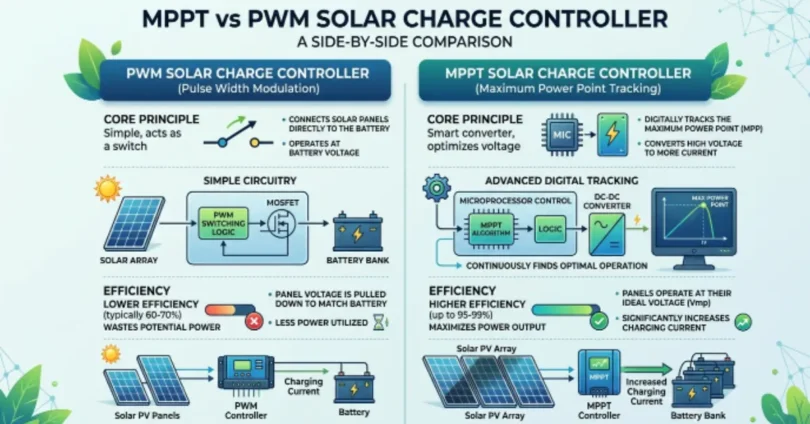
When setting up a solar power system, choosing the right controller is very important. MPPT vs PWM solar charge controller are the two main types you will find. Both help manage the energy from your solar panels, but they work differently and have different benefits.
Understanding MPPT vs PWM solar charge controller can save you money, improve efficiency, and make your solar system last longer. In this article, we will explain how they work, their differences, advantages, and which one is best for your needs.
What Is MPPT vs PWM Solar Charge Controller?
A solar charge controller is a device that protects your battery from overcharging and regulates power from solar panels. MPPT vs PWM solar charge controller are the two main types, and each works differently.
MPPT Solar Charge Controller
- Full form: Maximum Power Point Tracking
- How it works: It adjusts the voltage from solar panels to charge the battery efficiently.
- Efficiency: Can be 20–30% more efficient than PWM in certain conditions.
- Best for: Large solar systems and areas with variable sunlight.
PWM Solar Charge Controller
- Full form: Pulse Width Modulation
- How it works: It directly connects solar panels to the battery and regulates current in pulses.
- Efficiency: Simple and reliable but less efficient than MPPT in low sunlight.
- Best for: Small solar systems or budget setups.
Both types protect your battery, but MPPT is more advanced, while PWM is simpler and cheaper.
How MPPT vs PWM Solar Charge Controller Works
Understanding how MPPT vs PWM solar charge controller works helps you pick the right one for your solar system.
Working Principle of MPPT Solar Charge Controller
- Tracks maximum power: MPPT adjusts the panel voltage to get the highest possible power.
- Voltage conversion: It converts excess voltage into extra current for efficient battery charging.
- Works in all conditions: Performs well even on cloudy days or with partial sunlight.
- Saves energy: Can increase overall system efficiency by 20–30%.
Working Principle of PWM Solar Charge Controller
- Direct connection: PWM connects the solar panel to the battery in pulses.
- Voltage matching: It lowers the panel voltage to match the battery voltage.
- Simple control: Uses basic on/off pulses to regulate charging.
- Best for small systems: Works well for small setups but loses efficiency with higher voltage panels.
Comparison of Efficiency
- MPPT is more efficient: Especially with large panels and variable sunlight.
- PWM is simpler: Efficient only when panel and battery voltages are nearly equal.
- Energy savings: MPPT can save more electricity over time.
- Cost vs benefit: PWM is cheaper but may cost more in the long run due to lower efficiency.
MPPT vs PWM Solar Charge Controller: Key Differences
When you compare MPPT vs PWM solar charge controller, you will see clear differences in how they handle power, cost, and system design. These differences help you decide which one fits your solar setup best.
MPPT vs PWM Solar Charge Controller: Voltage and Current Handling
- MPPT adjusts voltage and converts extra power into useful current.
- It works with higher voltage solar panels easily.
- It extracts maximum power from the solar panel.
- PWM matches panel voltage directly with the battery.
- It reduces voltage to suit the battery level.
- It works best when panel and battery voltage are the same.
MPPT vs PWM Solar Charge Controller: Energy Efficiency
- MPPT gives higher efficiency in most conditions.
- It performs better in cloudy or changing weather.
- It can increase energy output by up to 30%.
- PWM offers lower efficiency compared to MPPT.
- It wastes some extra energy as heat or loss.
- It works fine in simple and small solar systems.
MPPT vs PWM Solar Charge Controller: Cost Comparison
- MPPT controllers are more expensive.
- They offer better long-term savings through efficiency.
- They are a good choice for big solar systems.
- PWM controllers are budget-friendly.
- They are cheaper to install and replace.
- They suit small home solar setups.
MPPT vs PWM Solar Charge Controller: Size and Complexity
- MPPT systems are more advanced and complex.
- They include smart tracking technology.
- They are usually larger in design.
- PWM systems are simple and easy to use.
- They have fewer electronic components.
- They are compact and beginner-friendly.
Advantages of MPPT vs PWM Solar Charge Controller
Both MPPT vs PWM solar charge controller have their own benefits. Understanding these helps you choose the best one for your solar system.
MPPT Solar Charge Controller Pros
- Higher efficiency: Extracts maximum power from solar panels.
- Works in low sunlight: Performs well even on cloudy days.
- Supports large systems: Ideal for bigger solar setups.
- Long-term savings: Reduces energy waste and increases output.
PWM Solar Charge Controller Pros
- Simple design: Easy to use and install.
- Lower cost: More affordable for small systems.
- Reliable: Less electronic complexity, fewer chances of failure.
- Compact size: Fits easily in small solar setups.
When to Choose Each
- Choose MPPT: For large solar systems, higher efficiency, and variable sunlight areas.
- Choose PWM: For small systems, limited budget, or simple setups.
- Consider your battery and panel setup: MPPT is best for mismatched voltage systems.
- Think about cost vs efficiency: PWM saves money upfront but MPPT saves energy over time.
Disadvantages of MPPT vs PWM Solar Charge Controller
Even though both MPPT vs PWM solar charge controller are useful, each one also has some limits. Knowing these helps you avoid mistakes when choosing for your solar system.
MPPT Solar Charge Controller Cons
- Higher cost: MPPT controllers are more expensive than PWM.
- Complex design: More advanced technology makes it harder to repair.
- Not needed for small systems: Overkill for simple or low-power setups.
- More sensitive: Needs proper setup for best performance.
PWM Solar Charge Controller Cons
- Lower efficiency: Cannot extract full power from solar panels.
- Energy loss: Wastes extra power as heat or unused energy.
- Limited performance: Not good for large solar systems.
- Less flexible: Works best only when panel and battery voltages match.
MPPT vs PWM Solar Charge Controller: Real-Life Examples
Seeing MPPT vs PWM solar charge controller in real-life setups helps you understand how they work in practice.
Small Solar System Example
- Type used: PWM is commonly used.
- Setup: 100–300W solar panel with 12V battery.
- Reason: Simple and cost-effective for small home use.
- Performance: Works well when sunlight is stable.
Large Solar System Example
- Type used: MPPT is preferred.
- Setup: 1kW or more solar panels with 24V or 48V battery.
- Reason: High efficiency and better energy output.
- Performance: Works well even on cloudy days or variable sunlight.
How to Choose the Right MPPT vs PWM Solar Charge Controller
Choosing the correct controller depends on your solar system size, budget, and needs.
Tips for Home Use
- Small systems (up to 500W): PWM is enough.
- For more efficiency or larger panels: MPPT is better.
- Check battery compatibility with the controller.
- Consider future expansion of your solar setup.
Tips for Commercial Systems
- Use MPPT for high power and large panels.
- Focus on long-term energy savings over initial cost.
- Ensure proper installation and maintenance for efficiency.
- Choose a reliable brand with warranty support.
Quick Checklist
- System size: Small → PWM, Large → MPPT.
- Sunlight conditions: Variable → MPPT, Stable → PWM.
- Budget: Limited → PWM, Flexible → MPPT.
- Efficiency need: High → MPPT, Basic → PWM.
FAQs on MPPT vs PWM Solar Charge Controller
Q. What is the main difference between MPPT and PWM solar charge controller?
A. MPPT adjusts voltage to get maximum power and is more efficient, while PWM simply matches panel voltage to the battery and is simpler.
Q. Which one is better, MPPT or PWM?
A. MPPT is better for large systems and variable sunlight. PWM is good for small systems or limited budgets.
Q. Can I use MPPT for a small solar system?
A. Yes, but it may be more expensive than needed for a small setup.
Q. Is PWM less efficient than MPPT?
A. Yes, PWM loses some energy and is less efficient, especially in larger systems or low sunlight.
Q. Which controller saves more electricity?
A. MPPT saves more energy because it extracts maximum power from solar panels.
Q. Can I switch from PWM to MPPT later?
A. Yes, but you may need to adjust your panels and battery setup for compatibility.
Q. Which is cheaper, MPPT or PWM?
A. PWM is cheaper upfront, but MPPT can save money in the long run through higher efficiency.
Conclusion
Choosing the right solar charge controller is important for your system. MPPT vs PWM solar charge controller both protect your battery and manage power, but they work differently.
- MPPT is best for large systems, higher efficiency, and areas with changing sunlight.
- PWM is simple, budget-friendly, and works well for small setups.
By understanding their differences, advantages, and limitations, you can pick the one that fits your needs and saves energy in the long run.